 Book now
Beyond the chapel: the Eremitani museums and Padua's painted city
What your Scrovegni Chapel ticket already covers, what sits next door, and how to see more of Padua's UNESCO fresco cycles around a 15-minute slot.
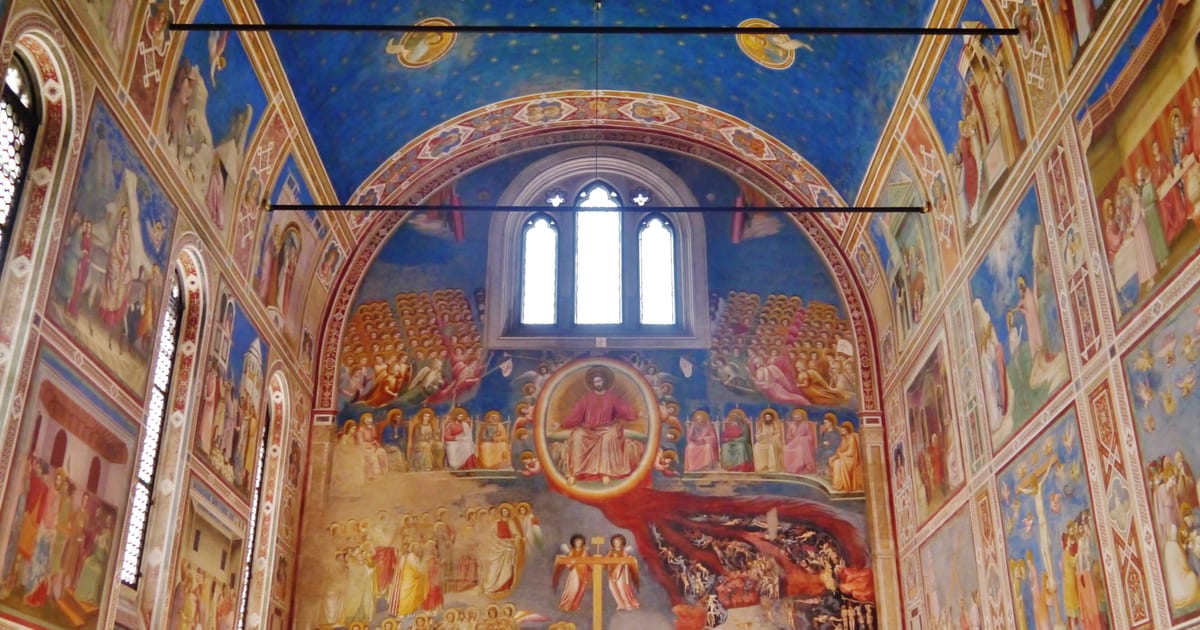
Your Scrovegni Chapel visit lasts about half an hour: 15 minutes in the climate-controlled waiting room, then 15 minutes under Giotto's blue vault. After that you step back out into Padua, often with most of the day still free. The useful news is that the same ticket already covers more. Every fare we book includes the Musei Civici Eremitani, the city museums in the old convent beside the chapel, and Palazzo Zuckermann from Tuesday to Sunday. Beyond them, the chapel is one of eight buildings that make up Padua's UNESCO-listed fresco cycles, known as Padova Urbs Picta, the painted city. This guide explains what is on your ticket, what is not, and gives you two simple plans that fit around a chapel slot.
What your chapel ticket includes
Every fare we book (Adult, EU visitors 65+, Ages 6–17 and Students) is a timed entry for one 15-minute chapel slot. Each one also includes the Musei Civici Eremitani, open every day from 9:00 to 19:00, and Palazzo Zuckermann, open Tuesday to Sunday from 10:00 to 19:00. You do not need a second ticket for either.
Mondays are the day to watch. On a Monday that is not a public holiday, Palazzo Zuckermann is closed, so your visit covers the chapel and the Eremitani museums only. If the decorative arts or the coin collection matter to you, choose a date from Tuesday to Sunday.
Children up to 5 go in free. We add under-6s to your booking at no charge, so they are on the same slot as you. The Church of the Eremitani next door and the other Urbs Picta buildings are not part of this ticket. We cover each of them below so you know what to expect.
The Eremitani complex: a friars' convent turned museum
The chapel's ticket office is inside the Musei Civici agli Eremitani, at Piazza Eremitani 8, about 100 m from the chapel. You collect your ticket here at least 30 minutes before your slot, so you will pass through the museum entrance whatever else you plan to do.
The museums fill the cloisters of the former convent of the Eremitani friars. These were Augustinian hermits, who arrived in Padua in 1237 and built the church next door between 1260 and 1276. Two museums share the space today: the Archaeological Museum and the Museum of Medieval and Modern Art.
Bags, backpacks, food and drink are not allowed in the chapel, and suitcases and trolleys are not allowed in the museum. Use the cloakroom or the lockers here, which take items up to 44 × 31 × 46 cm. Sort your bags out when you collect your ticket, not in the last few minutes before your slot.
The Archaeological Museum
The archaeological rooms run from the Veneti, the people of this region before Rome, through pre-Roman and Roman Padua. Expect tomb goods, portraits, statues and everyday objects, with a section on the Roman Via Annia and on the city in Roman times.
There is also an Egyptian section, much of it brought back by the Paduan explorer Giovan Battista Belzoni (1778–1823). It is a surprise to find in a city better known for frescoes, and it holds the attention of children who have had enough of painted saints.
If your time is short, put the picture gallery first and treat the archaeology as a bonus. The Crucifix and the Guariento panels connect straight back to the chapel and the wider fresco cycles. The Roman and Egyptian rooms tell a different story, and they are best enjoyed when you are not watching the clock.
Giotto's Crucifix and the picture gallery
The picture gallery, in the Museum of Medieval and Modern Art, holds the piece that links most directly to your chapel visit: Giotto's painted Crucifix from the early 1300s, which once hung over the chapel altar. Here you can stand in front of a single Giotto figure for as long as you like, which the 15 minutes under the vault never allows.
Close by are panels by Guariento, including his angels painted for the chapel of the Carrara palace, another of the eight Urbs Picta buildings. The collection then carries on to the 16th and 18th centuries, with several paintings by Veronese, Tintoretto's Supper in the House of Simon and his Crucifixion, and three works by Giambattista Tiepolo.
On the lower ground level, seven multimedia stations introduce the Scrovegni frescoes and their historical background. They work as a primer before the chapel or a recap after it. Ask at the ticket desk which order suits your slot when you collect your ticket.
Palazzo Zuckermann: applied arts and the Bottacin coins
Palazzo Zuckermann, at Corso Garibaldi 33, is part of the same civic museum group. It is a 20th-century building, put up between 1912 and 1914 for Enrico Zuckermann, and it houses two collections over three floors.
The ground and first floors hold the applied and decorative arts: more than two thousand pieces of craftsmanship from the Middle Ages to the present day. The second floor is the Bottacin Museum, built on the collection that Nicola Bottacin, a merchant and coin collector from Trieste, donated in 1865.
The Bottacin is mostly coins and medals: Greek, Roman and Byzantine coins, medieval and Renaissance pieces, coins from the Veneto and medals by Giovanni Cavino. There is also a bust of Doge Paolo Renier by Canova. Palazzo Zuckermann opens at 10:00 from Tuesday to Sunday, so it suits a mid-morning or afternoon visit rather than an early start.
The Church of the Eremitani and Mantegna's Ovetari Chapel
Beside the museums stands the Church of the Eremitani, dedicated to Saints Philip and James. It is a parish church in its own right, separate from the museums and not included in our ticket. It does belong to the UNESCO site, grouped with the Scrovegni Chapel in the same cluster.
Inside, look up at the wooden ceiling, built like an upturned ship's hull, and look for the surviving frescoes by Guariento and Ansuino da Forlì. The tombs of Jacopo II da Carrara and Ubertino da Carrara were moved here after the church of Sant'Agostino was demolished in 1819.
The Ovetari Chapel, in the right arm of the transept, is why many visitors step in. Andrea Mantegna, then about seventeen, worked on its stories of Saint James and Saint Christopher between 1448 and 1457 with other painters, and he is credited with the overall layout. On 11 March 1944 an Allied bombing destroyed most of the cycle; the church stood next to a German headquarters.
Two scenes, the Assumption and the Martyrdom of Saint Christopher, survived because they had been detached from the walls around 1880. More than 88,000 fragments of the rest survive, covering only 77 square metres. In 2006, for Mantegna's 500th anniversary, they were set back in the chapel alongside reconstructions. It is a sobering thing to see after Giotto's intact walls.
Urbs Picta: Padua's fourteenth-century fresco cycles
On 24 July 2021 UNESCO inscribed Padua's fourteenth-century fresco cycles on the World Heritage List. The site is also known as Padova Urbs Picta, the painted city. It brings together eight buildings in four clusters in the historic centre, with frescoes painted between 1302 and 1397.
Giotto opens the sequence at the Scrovegni Chapel. The painters who followed him in Padua over the rest of the century include Guariento, Giusto de' Menabuoi, Altichiero da Zevio, Jacopo Avanzi and Jacopo da Verona. Seeing several of the buildings shows you how Giotto's way of telling a story in paint was taken up by the next generations.
The four clusters are: the Scrovegni Chapel with the Church of the Eremitani; Palazzo della Ragione, the chapel of the Carrara palace and the cathedral Baptistery; the Basilica of St Anthony with the Oratory of San Giorgio; and the Oratory of San Michele. Our ticket covers the chapel and the museums only. None of the other buildings is included, and their opening hours vary, so check each one before you go.
A sensible order for the other fresco cycles
The clusters make a natural route. Start with the one you are already in: chapel, museums and the Eremitani church. Then move into the centre for the second cluster, which has the most to see.
Palazzo della Ragione was Padua's medieval town hall and court, and its ground floor has held the city market for about 800 years, between Piazza delle Erbe and Piazza dei Frutti. Upstairs, the great hall is about 81.5 m long and 24 m high. Giotto was the first to fresco its walls. After a fire in 1420, the surfaces were repainted between 1425 and 1440 with a scheme linking the months to the signs of the zodiac, to trades and to human characters. A wooden horse from 1466 stands at the western end.
In the same cluster are the cathedral Baptistery, with frescoes by Giusto de' Menabuoi, and the chapel of the Carrara palace, whose Guariento angels you will already have seen in the Eremitani gallery. The third cluster is the Basilica of St Anthony, where the Chapel of St James has frescoes by Altichiero da Zevio and Jacopo Avanzi, paired with the Oratory of San Giorgio, painted by Altichiero. The Basilica is a working church, so dress and behave accordingly.
Last comes the small Oratory of San Michele, with frescoes by Jacopo da Verona. It sits on its own as the fourth cluster, so it is the easiest one to leave for a second visit if your day runs short.
A half-day plan around your chapel slot
Take a 10:00 slot as the example. Be at the ticket office at Piazza Eremitani 8 by 9:30 to collect your ticket and leave bags in the cloakroom or lockers. Walk the 100 m to the chapel and be at the entrance pavilion by 9:55. Late arrival means no entry, and the ticket cannot be moved to another slot, so give yourself slack.
You spend 15 minutes in the waiting room and 15 minutes in the chapel, and you are out at around 10:30. Walk back to the Eremitani for Giotto's Crucifix, the Guariento angels and the multimedia stations, then the archaeological rooms if you still have energy.
Finish at the Church of the Eremitani next door for Mantegna's fragments in the Ovetari Chapel. That fills a morning in one corner of the city, with no bus or taxi needed after you arrive.
The same plan works on a Monday that is not a public holiday, because the Eremitani museums are open every day. Only Palazzo Zuckermann is closed then, and it is not part of this half-day route anyway.
A full-day plan
For a full day, keep the same morning and add the centre in the afternoon. A morning slot leaves the rest of the day open. From Tuesday to Sunday, fit Palazzo Zuckermann in after the Eremitani museums, since it opens at 10:00.
After lunch around Piazza delle Erbe, go up to the great hall of Palazzo della Ragione, then on to the Baptistery. Later in the afternoon, head to the Basilica of St Anthony and the Oratory of San Giorgio. Keep the Oratory of San Michele for the end of the day or for another visit.
If you prefer an afternoon slot, reverse the order: the centre in the morning, then the ticket office at least 30 minutes before your slot. The Eremitani museums stay open until 19:00, so an early or mid-afternoon slot still leaves you time inside them afterwards.
Frequently asked
What does a Scrovegni Chapel ticket include besides the chapel?
Every fare we book includes the Musei Civici Eremitani every day, and Palazzo Zuckermann from Tuesday to Sunday. On Mondays that are not public holidays Palazzo Zuckermann is closed, so the ticket covers the chapel and the Eremitani museums.
Can I see the Giotto Crucifix that hung in the chapel?
Yes. Giotto's painted Crucifix, which once hung over the chapel altar, is in the picture gallery of the Musei Civici Eremitani, and the museums are included with your chapel ticket.
Is the Church of the Eremitani with Mantegna's frescoes included?
No. The Church of the Eremitani is a separate parish church next to the museums and is not part of our ticket. It is home to the Ovetari Chapel, with what survives of Mantegna's frescoes after the 1944 bombing.
Does the ticket cover the other Urbs Picta buildings?
No. Our ticket covers the Scrovegni Chapel, the Eremitani museums and Palazzo Zuckermann (Tuesday to Sunday). Palazzo della Ragione, the Baptistery, the Carrara palace chapel, the Basilica of St Anthony, the Oratory of San Giorgio and the Oratory of San Michele are not included. Check their opening hours before you go.
Can I change my chapel slot if I want more time in the museums?
No. Tickets are non-refundable and cannot be changed in date or time, and there are no same-day bookings. Pick your slot with your plan for the day in mind, and arrive at the ticket office at least 30 minutes before it.
Where do I leave my bag?
Bags, backpacks, food and drink are not allowed in the chapel, and suitcases and trolleys are not allowed in the museum. Use the cloakroom or lockers at the Musei Civici Eremitani when you collect your ticket. The lockers take items up to 44 × 31 × 46 cm.
What if the date I want is not on sale yet?
Day slots are currently on sale up to 10 February 2027, and the next batch has no published date. We can hold later dates, or fully booked ones, on our waiting list with no payment. When a place can be booked we email you a secure payment link, though we can't promise a place opens. The chapel is closed 16–27 November 2026, and on 25 and 26 December and 1 January.