 Book now
Your Scrovegni Chapel visit, from the ticket office to the vault
How long it takes, where to be and when, what stays in the locker, and what to look at in your 15 minutes with Giotto.
A visit to the Scrovegni Chapel is short, carefully timed and worth every minute of planning. You spend 15 minutes in a climate-controlled waiting room, then 15 minutes with Giotto's frescoes, in a group of no more than 25 people. Around that half hour sit a few fixed steps: collecting your ticket at the Musei Civici agli Eremitani, leaving your bag, walking about 100 metres to the chapel and being at the entrance pavilion on time. None of it is complicated. The timings are strict, though, and a late arrival means no entry. This guide walks through the day in order, from the ticket office to the starry vault and out again, so you know where to be and when.
How long the visit takes
The part inside the chapel buildings lasts about 30 minutes: 15 minutes in the waiting room of the entrance pavilion, then 15 minutes in the chapel itself. Entries run every 15 minutes, from 9:00 to the last day slot at 18:45, and each slot holds a maximum of 25 people, guides included.
Then add the time before. You need to be at the ticket office at least 30 minutes before your slot, and at the chapel entrance at least 5 minutes before it. From reaching the ticket office to walking back out of the chapel, plan on roughly an hour. If you want to see the museums that come with the ticket, and you should, keep the rest of the morning or afternoon free as well.
Here is how a 10:30 slot works in practice. Be at the ticket office by 10:00, collect your ticket and leave your bag, then walk across the gardens and reach the entrance pavilion by 10:25. At 10:30 your group goes into the waiting room. At about 10:45 the chapel doors open, and at about 11:00 you are back outside, free to head into the museums.
The chapel is open all year except 25 and 26 December, 1 January, and 16 to 27 November 2026, when it closes for the annual inspection of the frescoes by the Istituto Centrale per il Restauro.
Before you travel: your ticket and your slot
Advance booking is compulsory, and there are no same-day bookings. When you book with us you choose a date and a 15-minute slot, and your e-ticket comes to you by email. Every fare we offer (Adult, EU visitors 65+, Ages 6–17 and Students) is a timed entry for one slot. It also covers the Musei Civici Eremitani, plus Palazzo Zuckermann from Tuesday to Sunday.
Two rules matter here. Tickets are non-refundable, and the date and time cannot be changed once booked. That is the chapel's rule and it applies to everyone. So pick a slot that leaves slack in your day: not straight off an early train, and not squeezed between two other bookings.
If you have booked a reduced fare, bring the proof. EU visitors 65+ should carry an ID showing citizenship and age. Students need a valid student card. Staff may ask to see them, so keep them with your ticket rather than in a locked bag.
Once a slot is full it cannot be booked. Day slots are currently on sale up to 10 February 2027, and the next batch has no published release date. If the date you want is fully booked, or falls beyond that, you can join our waiting list with no payment. If a place can be booked, we email you a secure payment link. We can't promise a place opens, so if your dates are fixed, book early.
Arriving at the ticket office
The ticket office is not at the chapel. It is at the entrance of the Musei Civici agli Eremitani, Piazza Eremitani 8, about 100 metres away. This is where your visit starts, and where you should arrive at least 30 minutes before your slot to collect your ticket.
Thirty minutes sounds generous. In practice it covers finding the entrance, queuing at the desk, dealing with bags and the short walk, with a few minutes left to breathe. If you are coming by bus or tram from the railway station, build in a margin for that connection too. Our guide to getting there covers the routes.
Have your booking email open on your phone, or printed, before you reach the desk. It saves fumbling at the front of the queue.
Bags, lockers and what stays behind
Backpacks and bags cannot go into the museum or the chapel. They go into the cloakroom or the lockers before you enter. The lockers measure 44 × 31 × 46 cm, which takes a day pack or a handbag but not much more.
Suitcases and trolleys are not allowed in at all. If you arrive in Padua with luggage, leave it at your hotel or a left-luggage service first. Don't count on the museum taking it.
Food, drink and animals are not allowed in the chapel either, and phones must be on silent. Keep your ticket, your phone and any proof of a reduced fare in a pocket. That is all you will carry in.
The short walk through the Arena gardens
From the ticket office, the chapel is a walk of about 100 metres through the Giardini dell'Arena, the green space that stretches between the chapel and the Piovego canal. The gardens take their name from Padua's Roman amphitheatre, built around 70 AD.
That is also why you will hear the building called the Arena Chapel. Enrico Scrovegni bought the land beside the old arena on 6 February 1300, and the chapel was dedicated on 25 March 1303. Walk at an easy pace. If you collected your ticket on time, there is room in the schedule for it.
The chapel is dedicated to Santa Maria della Carità, though everyone knows it by the family name of the man who paid for it. Enrico's father, Reginaldo Scrovegni, had the misfortune of being placed by Dante among the usurers in canto XVII of the Inferno. It is a good story to have in mind as you walk over to the entrance.
The entrance pavilion and the 15-minute wait
You don't walk straight into the chapel. Visitors go in through a modern entrance pavilion, the Corpo Tecnologico Attrezzato, or C.T.A., installed beside the chapel in 2000. Be at its entrance, ticket in hand, at least 5 minutes before your slot.
Inside, your group waits for 15 minutes in a climate-controlled room. It can feel like a delay. It isn't. Every visitor brings in warmth and moisture from outside, and this room lets your body humidity drop and filters out smog dust, so the chapel's microclimate stays stable for frescoes painted more than seven centuries ago.
This system is a large part of why the chapel can be visited at all. The frescoes were restored by the Istituto Centrale per il Restauro from June 2001, after a preparation study lasting over 20 years, and the chapel reopened in March 2002. The pavilion, the small groups and the strict timings all protect that work.
Use the wait well. Check your phone is on silent, put away anything you won't need, and decide what you want to look at first. The automatic doors open once to let you in and once to let you out, so there is no stepping out halfway and coming back.
Fifteen minutes with Giotto
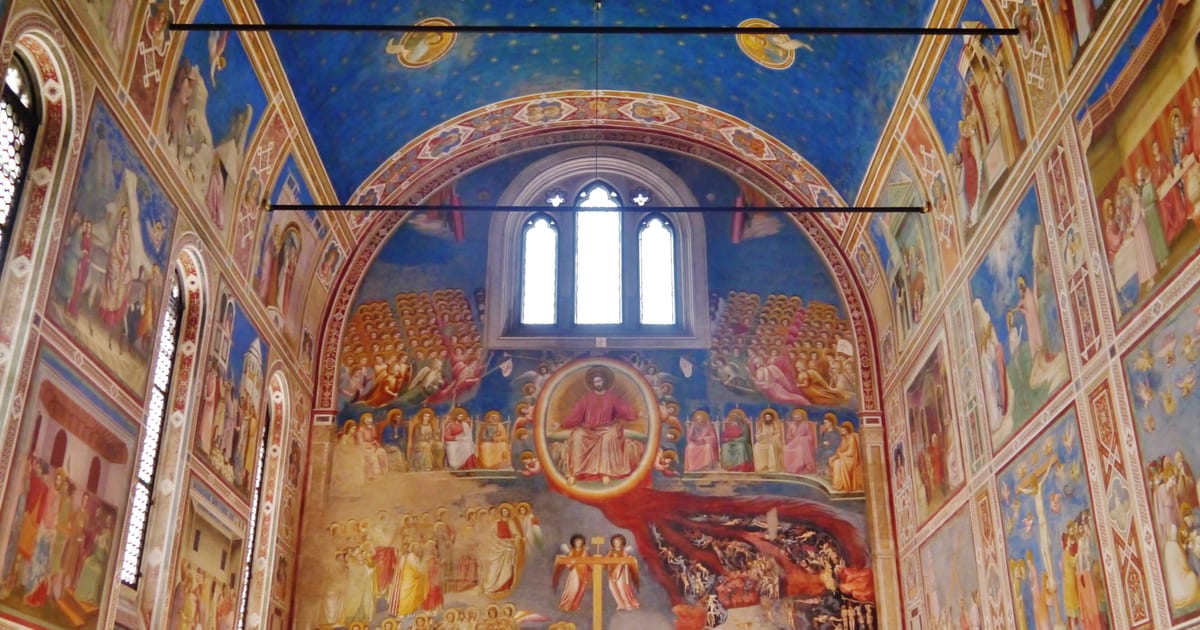
The doors open and you are in a single nave covered with Giotto's frescoes across its whole interior, painted in about two years, between 1303 and 1305. Fifteen minutes goes quickly, so it helps to arrive with a plan.
Look up first. The vault is a deep blue sky studded with eight-point stars, with roundels of Christ, the Madonna and Child, and the prophets. Then follow the story: 38 narrative panels in four tiers along the walls and the triumphal arch, telling the lives of the Virgin and of Christ, with the Annunciation on the arch. Look for the Meeting at the Golden Gate, the Kiss of Judas and the Lamentation.
Below the stories run the Vices and Virtues, 14 figures painted in grisaille. Then turn round. The entrance wall holds the Last Judgement, where you will find a small painted model of the chapel itself. In the presbytery stands Giovanni Pisano's Madonna and Child between two angels, from the early 1300s. Our frescoes guide goes through the walls in more detail.
Photography for personal use is allowed, with conditions: no flash or other lights, no tripods, no equipment, and no touching. A few photos are fine. Most people find the time is better spent looking.
If you are running late
This is the one part of the visit with no give. If you reach the entrance after your slot has gone in, you cannot enter. Tickets cannot be moved to a later time or refunded, and the chapel's rule is that you would have to book and pay for another slot.
That is why the 30-minute and 5-minute margins matter. Treat your slot like a train departure rather than a restaurant booking.
A few habits help. Avoid slots right after a train arrival. Check the walk from your hotel the day before. And if you visit the Eremitani museums before your slot, keep an eye on the clock.
After the chapel: the museums on your ticket
Your ticket doesn't end at the chapel door. Every fare includes the Musei Civici Eremitani, open daily from 9:00 to 19:00 in the cloisters of the former convent of the Eremitani friars. It holds the Archaeological Museum and the Museum of Medieval and Modern Art.
Two things there connect directly to what you have just seen. Giotto's painted Crucifix, which once hung over the chapel altar, is in the collection. The museum also has seven multimedia stations that introduce the chapel's frescoes, a good place to catch what fifteen minutes couldn't.
From Tuesday to Sunday the ticket also covers Palazzo Zuckermann, open 10:00 to 19:00, with its applied and decorative arts collections and the Bottacin Museum of coins. On ordinary Mondays Palazzo Zuckermann is closed.
The chapel is one of eight buildings in the UNESCO World Heritage listing for Padua's fourteenth-century fresco cycles, inscribed in 2021. If Giotto has caught you, the others, from the Palazzo della Ragione to the Baptistery, are in the same city.
Children, accessibility and choosing a time
Children up to 5 go in free. We add them to your booking at no charge, so they are counted in the group. Ages 6–17 have their own fare. The visit does ask children to wait quietly for 15 minutes before going in, so giving them something to find helps: the stars on the ceiling, or the little model of the chapel in the Last Judgement.
Under the chapel's rules, disabled visitors and a companion are admitted free. The operator publishes no detail on access to the entrance pavilion or the chapel, such as steps or space for a wheelchair, so please email us before booking and we will go through your needs with you before anything is paid.
Slots run every 15 minutes from 9:00 to 18:45, all year. Given that a late arrival means no entry, the best slot is simply the one you can reach comfortably.
Frequently asked
How long does a Scrovegni Chapel visit take?
About 30 minutes at the chapel: 15 minutes in the climate-controlled waiting room and 15 minutes inside. With the 30 minutes you need at the ticket office beforehand, plan on roughly an hour, plus time for the museums on the same ticket.
How early should I arrive?
Be at the ticket office at the Musei Civici agli Eremitani, Piazza Eremitani 8, at least 30 minutes before your slot to collect your ticket. Then be at the chapel's entrance pavilion, about 100 metres away, at least 5 minutes before your slot.
Can I take a backpack or suitcase in?
No. Backpacks and bags go into the cloakroom or the lockers, which measure 44 × 31 × 46 cm. Suitcases and trolleys are not allowed in at all, and food, drink and animals are not allowed in the chapel.
Can I take photos inside the chapel?
Yes, for personal use, as long as you use no flash or other lights, no tripods or other equipment, and touch nothing.
What happens if I miss my slot?
Late arrival means no entry. Tickets are non-refundable and cannot be changed in date or time, so you would need a new booking for another slot. Arriving at the ticket office 30 minutes early is the simplest protection.
Do young children need a ticket?
Children up to 5 are admitted free. We add them to your booking at no charge so they are counted in your group. Ages 6–17 have their own fare.
What if my date is fully booked?
Day slots are currently on sale up to 10 February 2027, and the next batch has no published date. For fully booked dates, or dates beyond that, you can join our waiting list with no payment. If a place can be booked, we email you a secure payment link. We can't promise a place opens.